07 · story
I asked AI to find me a black hole. It found something else.
I am not an astronomer. One evening I gave Claude the public data of two space telescopes, asked for a black hole and went to bed. By morning it had a star that flashed at exactly the right moment.
The wish
A few days earlier I had read about people with no astronomy training who found a possible dwarf planet with AI. It had been sitting in public pictures for ten years. So I went for the biggest prize I could think of: a black hole nobody has seen.
A black hole that is not eating anything is invisible. But there is one trick for catching it.
A magnifying glass made of gravity
Many stars live in pairs. Sometimes one of the two has already died and shrunk into something tiny and very heavy: a white dwarf, a neutron star or a black hole. You cannot see it. But when it passes exactly between us and its partner, its gravity bends the partner’s light toward us. For a few hours the living star looks a little brighter.
Slide the dead star across the living one
+0.00 % brighter
A white dwarf, about the size of Earth: the star gets about 0.4 % brighter. That is the flash in this story.A black hole ten times heavier than the Sun: about 4 % brighter. Easy to see. But the line-up has to be almost perfect, so it is very rare.
The glow is exaggerated so you can see it. Nothing here is to scale.
Astronomers call this self-lensing. In the whole sky only five such pairs were known. All five have a white dwarf, and all were found by one telescope, Kepler.
Two telescopes, both free
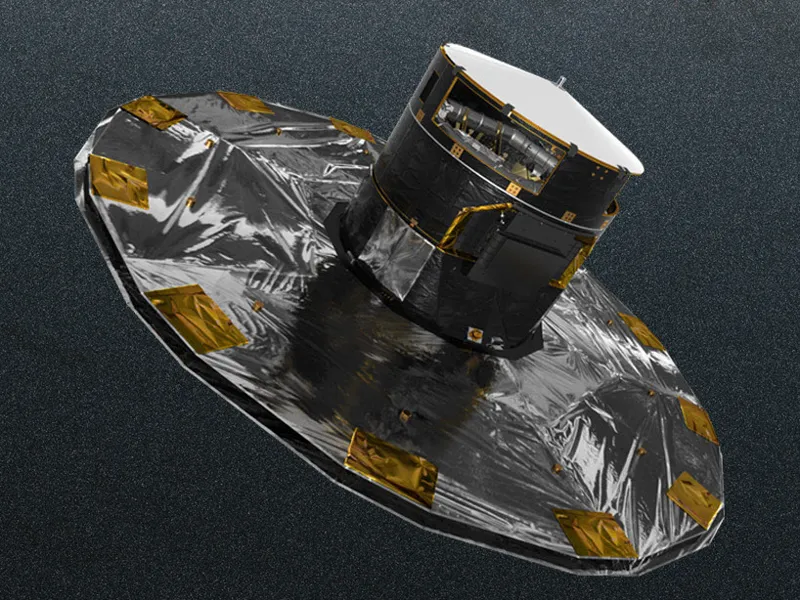
Gaia says when
A European telescope built to make a 3D map of the Milky Way. To do that it measured how about two billion stars move. Some speed up and slow down, because something unseen is pulling on them. From that pull you can work out when the unseen thing passes in front.
Drawing: ESA, CC BY-SA 3.0 IGO
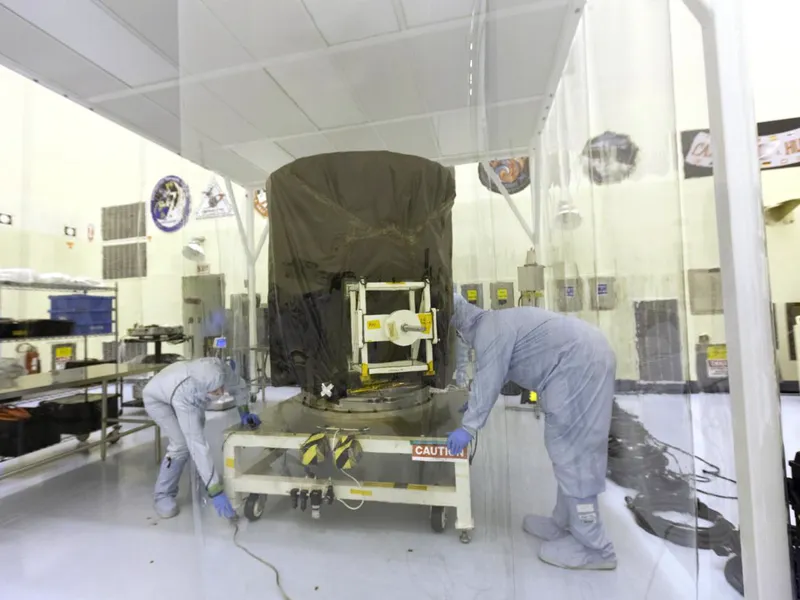
TESS says if
A NASA telescope built to hunt for planets around other stars. It does that by measuring how bright stars are, every few minutes, for about a month at a time. So it can also tell whether a star flashed.
TESS before launch. Photo: NASA / Ben Smegelsky
Anyone can download both. That was the plan for the night: let Gaia say when to look, and let TESS say whether anything happened.
The night
Claude picked 186 stars that Gaia says have a heavy, dark partner and that TESS had watched. For each one it worked out when a flash was due, and looked there.
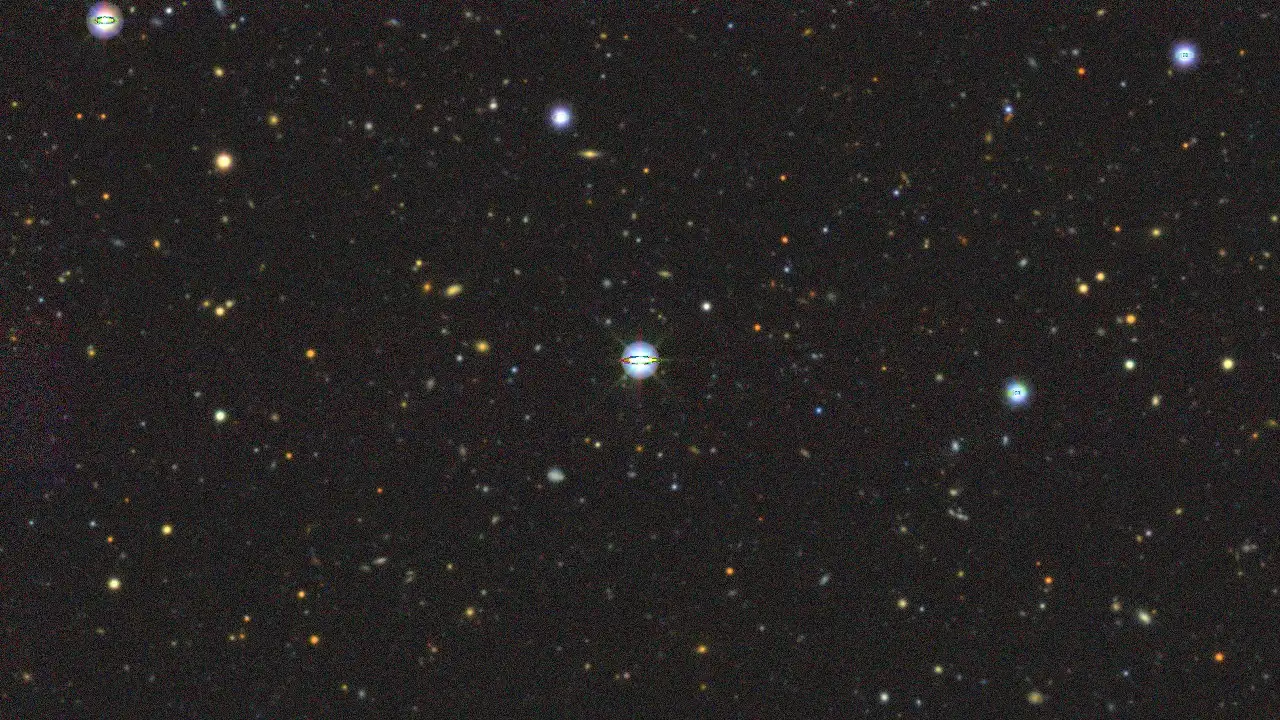
One month in the life of one star
Every dot is two hours of real TESS data for the star TIC 92198581, 720 light-years away, in autumn 2020. Can you spot it?The yellow band is when Gaia says the dark partner should pass in front, give or take 5.5 days. The flash is one day from the middle of it.Close up: about 0.4 % brighter for three and a half hours. The line is the shape a gravity lens should make.
Gaia also says how heavy the dark partner is: a bit more than half of our Sun. Too light for a black hole. Just right for a white dwarf.
Then I tried to break it
Finding a bump is easy. Stars flicker and cameras hiccup. So the next day I asked Claude to attack its own result.
- The cameraIt went back to the raw pictures. The extra light sits exactly on the star, and no neighbour is close enough to blame.
- The clockIt tested its timing sums on 1,713 ordinary eclipses of other stars. They arrived when predicted, usually within three hours.
- The look-alikesIt graded 135 strong bumps from other stars without knowing which was mine or when any was due. Two got top marks. Mine was the only one that also came at the right time.
It also caught two of its own mistakes. One had made the result look weaker than it is, the other stronger. Both are fixed.
What does not fit
The flash is about one and a half times brighter than it should be for a partner that light. And TESS saw it only once.
My honest odds that it is a coincidence: somewhere between 1 in 20 and 1 in 100.
So this is a candidate. Not a discovery.
What happens now
I published the data and wrote to the astronomers who study exactly these pairs. A few measurements with a big telescope would settle it. So would a second flash: the next ones are due around 26 April and 11 November 2027.
If it holds, it is the sixth pair of its kind, found by an amateur overnight.
And I still want my black hole. In December Gaia releases far more data. Same trick, run again.